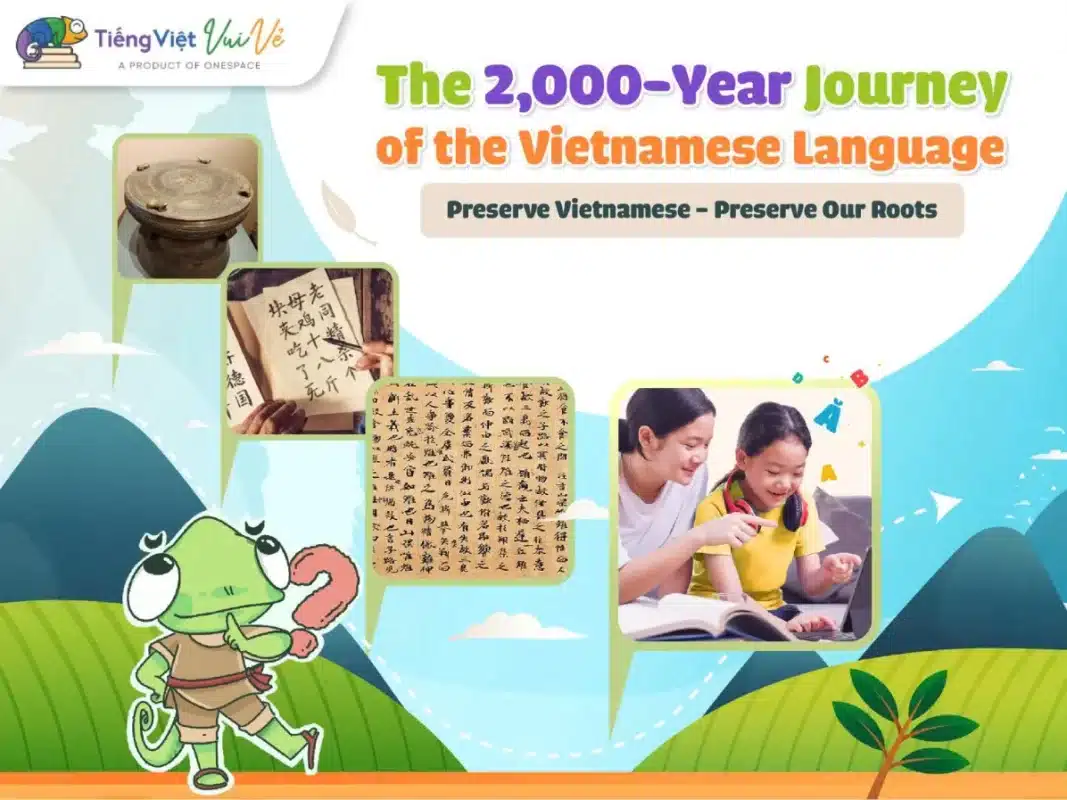
Vietnamese is not just a means of communication. It is also a powerful thread connecting the culture, history, and roots of the Vietnamese people.
Few realize that the origins of the Vietnamese language and its development span thousands of years—from ancient engravings on bronze drums to the familiar Quốc Ngữ writing system used today.
Understanding the origins of Vietnamese not only fosters cultural pride but also reminds us that preserving the language means preserving the roots of every Vietnamese person.
1. The origins of the Vietnamese language from Bronze Drum Symbols

From early in history, ancient Vietnamese communities had a need to record and share information about their lives, beliefs, and society.
One of the clearest traces that remain today can be found in the Đông Sơn bronze drums (circa 7th century BCE – 1st century CE).
On these drums, we can see various symbolic images such as:
- People dancing, working, and engaging in community life
- Lạc birds flying in the sky
- Boats traveling across rivers
- Sun symbols and geometric patterns
Although these are not a complete writing system, many researchers consider them a form of pictorial communication, similar to early ideographic writing.
They reflect the worldview, spiritual life, and culture of ancient Vietnamese people—and show that even early on, there was a desire to preserve and transmit information through symbols.
2. The Introduction of Chinese Characters in Vietnam
A major turning point in Vietnam’s writing history occurred in 111 BCE, when the Han Dynasty annexed Nam Việt, marking the beginning of nearly a thousand years of Chinese rule.
During this period, Chinese characters (Hán tự) became the primary writing system used in:
- Government administration
- Education and examinations
- Historical records
- Literature and poetry
Even after Vietnam regained independence in 939 CE, Chinese characters continued to be widely used in administration and academia for centuries, especially in Confucian examinations from the 11th to early 20th century.
However, Chinese characters did not fully reflect the sounds and structure of the Vietnamese language. This led to the creation of a unique writing system tailored to Vietnamese.
3. Chữ Nôm – A Unique Vietnamese Innovation
Between the 10th and 13th centuries, Vietnamese scholars developed Chữ Nôm, a writing system created by modifying and combining Chinese characters to represent Vietnamese sounds.
This marked a significant milestone, as it was the first time the Vietnamese spoken language was recorded directly in writing.
Chữ Nôm flourished in literature from the 15th century, especially during the reign of Emperor Lê Thánh Tông (1460–1497).
Notable works written in Chữ Nôm include:
- The Tale of Kiều by Nguyễn Du (early 19th century)
- Chinh Phụ Ngâm
- Various folk poems and literary works
The development of Chữ Nôm played a crucial role in affirming Vietnam’s distinct cultural and linguistic identity.
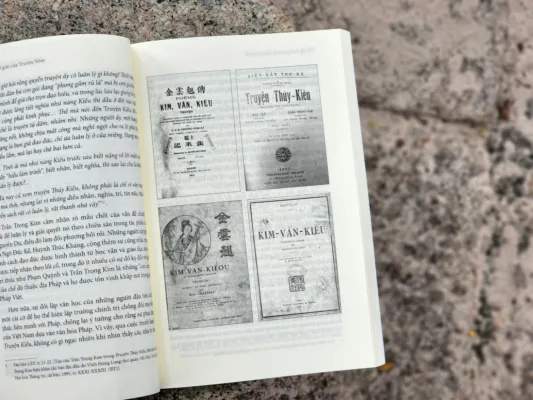
4. Quốc Ngữ – A Major Turning Point for Vietnamese
In the 17th century, Western missionaries began developing a system to transcribe Vietnamese using the Latin alphabet.
A key milestone came in 1651, when missionary Alexandre de Rhodes published the dictionary Dictionarium Annamiticum Lusitanum et Latinum in Rome.
However, it was not until the late 19th and early 20th centuries that Quốc Ngữ became widely adopted.
In 1919, the Nguyễn dynasty officially abolished the Confucian examination system, paving the way for Quốc Ngữ to become the dominant writing system in education and administration.
Thanks to its advantages:
- Easy to learn and widely accessible
- Accurately reflects Vietnamese pronunciation
- Convenient for education and communication
Quốc Ngữ quickly became the official writing system and remains in use today.
5. Why Learning Vietnamese Helps Children Stay Connected to Their Roots
For many Vietnamese families living abroad, there is a common concern:
Children may speak English, German, or French fluently and adapt quickly to new environments. But over time, Vietnamese is used less and less.
At first, they may struggle to speak. Then they understand but don’t respond. Eventually, they may listen but cannot read or write.
Vietnamese—the language of their homeland—gradually becomes a “secondary language.”
Looking globally, many communities such as the Chinese maintain strong cultural identities through Chinatowns and cultural networks worldwide. They understand that a tree can only grow tall if its roots are strong.
Parents want their children to become global citizens. But to stand confidently in the world, children must also know where they come from—and Vietnamese is the bridge that preserves that connection.
Learning Vietnamese is not just about communication with family. More importantly, it helps children:
Stay connected to their roots, no matter where they live
Preserve their identity
Take pride in their heritage
6. Tiếng Việt Vui Vẻ – A Vietnamese Learning Program for Children Abroad
The program does not treat learning Vietnamese as a forced task. Instead, lessons are designed to be engaging, interactive, and relatable, sparking children’s natural interest in the language. When children enjoy learning, they become more willing to speak Vietnamese, use it in daily life, and gradually develop a love for their mother tongue.
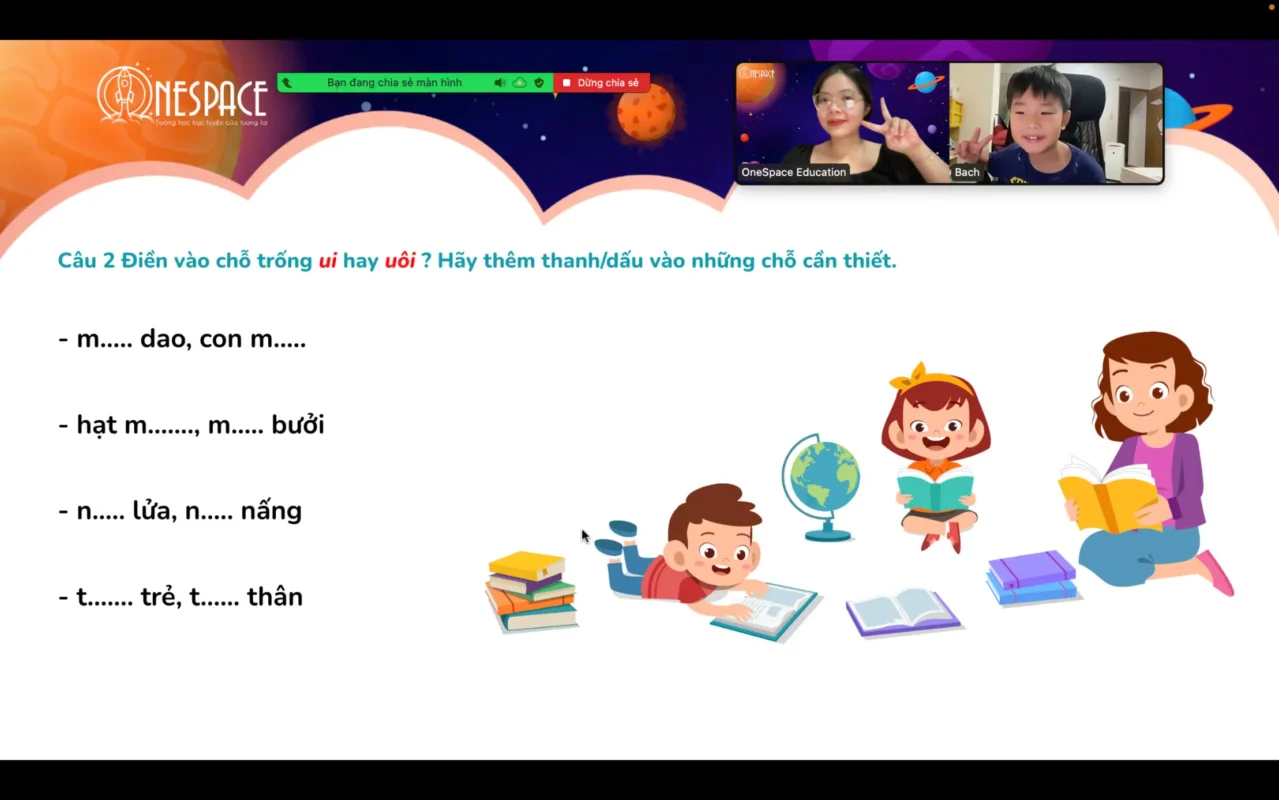
Through age-appropriate activities, the program helps children develop all four skills:
- Listening
- Speaking
- Reading
- Writing
More importantly, it builds confidence and encourages children to explore Vietnamese culture, history, and identity.
📩 If parents are interested in the Tiếng Việt Vui Vẻ program, please contact OneSpace for more information about upcoming classes.
Detailed information about Tiếng Việt Vui Vẻ classes!
Explore useful technology courses at OneSpace!