Technology giants in the United States, China, and beyond are continuously launching new AI models. AI can write content, generate images, assist with coding, analyze data, and process information. It is also becoming increasingly integrated into tasks that once required human expertise and effort.
Yet behind the race to build the most powerful AI lies a much bigger question:
- If AI can do more and more, what will humans do in the future?
- What do children today need to prepare for a job market they will enter 10–20 years from now?
Is AI Really Going to “Steal” Our Jobs?
This is a concern shared by many people. However, the reality is far more complex than the simple equation: AI emerges → humans lose their jobs.
Consider a familiar workplace scenario. In the past, an employee might have spent several hours compiling information and summarizing documents. Today, AI can help complete the same task in significantly less time.
A software developer can ask AI for code suggestions.
A marketing professional can use AI to brainstorm ideas.
A designer can use AI to generate initial drafts.
Jobs do not necessarily disappear, but the way people work is changing. According to the PwC Global AI Jobs Barometer 2026, skills are changing more than twice as quickly in jobs highly exposed to AI as in those less exposed to it. Notably, emerging tasks in these roles increasingly call for capabilities such as creativity, judgment, and human interaction.
Put simply, the more AI can do, the more important it becomes for people to know how to work with it.
What Skills Will Children Need 10–20 Years from Now?
This is the question parents should be paying attention to.
No one can predict with certainty which careers will be in demand when today’s children enter the workforce. Jobs that do not even have names yet may become commonplace. Meanwhile, familiar professions may be transformed by AI in ways we cannot fully anticipate today.
So, instead of trying to predict what career their children should pursue, parents can take a more practical approach: equip children with the ability to adapt to an uncertain and constantly changing future.
For example, children need to develop the ability to:
- Think critically: Go beyond accepting AI-generated answers by learning to ask questions, evaluate information, and verify facts.
- Be creative: Move beyond using ready-made tools to turn their own ideas into original creations.
- Solve problems: When faced with an unfamiliar challenge, explore different approaches rather than simply waiting for someone else to provide the answer.
- Understand technology: Learn what AI can do, recognize its limitations, and use it appropriately.
This approach is also reflected in UNESCO’s AI Competency Framework for Students. The framework emphasizes that students should not only understand AI but also progressively learn to apply and create with it, while developing the ability to evaluate and use technology responsibly.
Should Children Wait Until They Are Older to Learn About AI?
There is an interesting paradox here. Adults are learning to use AI to adapt to changes in the workplace. Meanwhile, children can begin exploring AI and technology while they are still developing their ability to ask questions, experiment, and create things of their own.
UNESCO has also developed an AI competency framework for students built around three progressive levels: Understand – Apply – Create. The goal is to help children become responsible users and co-creators of AI rather than passive consumers of technology.
That is why introducing AI to children does not have to begin with complex algorithms. A suitable learning journey can start with simple, progressive steps:
Understand what AI is → discover what AI can do → learn to use AI → evaluate and control its outputs → combine AI with their own thinking → create original products.
This is the difference between simply using AI and mastering AI.
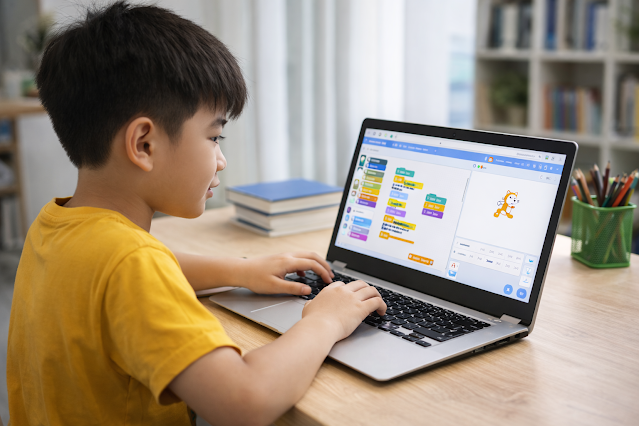
OneSpace: Bringing AI Beyond the Screen and Into Children’s World of Creativity
Rather than limiting children to observing AI through existing tools, OneSpace develops learning programs that encourage them to learn, experiment, create, and apply technology in practice.
Generative AI – Turning AI Into a Creative Toolkit
Discover the Generative AI Course
Through Generative AI, children have the opportunity to explore how AI generates content and helps develop ideas.
Instead of simply pressing a button and letting AI do the work for them, children learn how to craft effective prompts, develop ideas, and leverage technology to create original work of their own.
Starting with an initial idea, they can gradually begin asking questions such as:
“What can AI do?” → “What can I use AI for?” → “What new things can I create?”
This is the transition from being a technology user to becoming a creator who builds alongside technology.
AI Hackstack – Learning AI Through Problem-Solving
Discover the AI Hackstack Course
While Generative AI opens the door to creativity, AI Hackstack brings children closer to practical AI applications through hands-on learning. They explore technology, develop logical thinking, and learn to solve problems instead of simply absorbing information passively.
The goal is not to turn every child into an AI engineer. It is to help them develop an essential way of thinking:
Identify a problem → explore how technology can help → experiment → learn from mistakes → create a solution.
This is precisely the kind of mindset that is becoming increasingly valuable in a world where technology continues to evolve.
Ready to Move From Learning to Competition? Meet ENJOY AI.
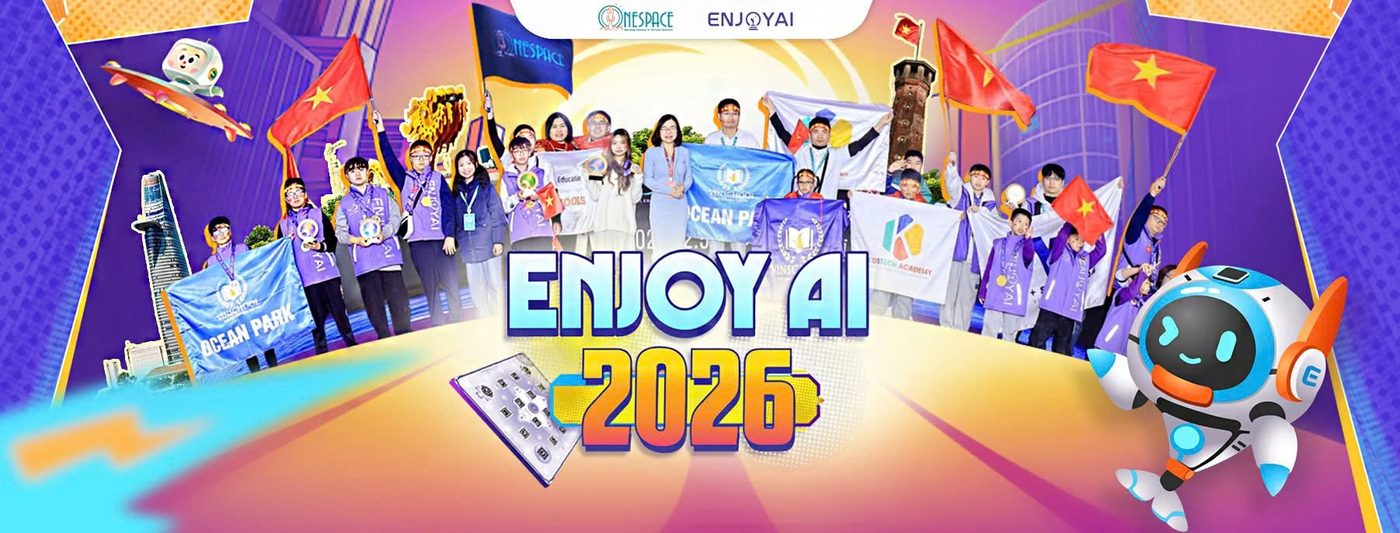
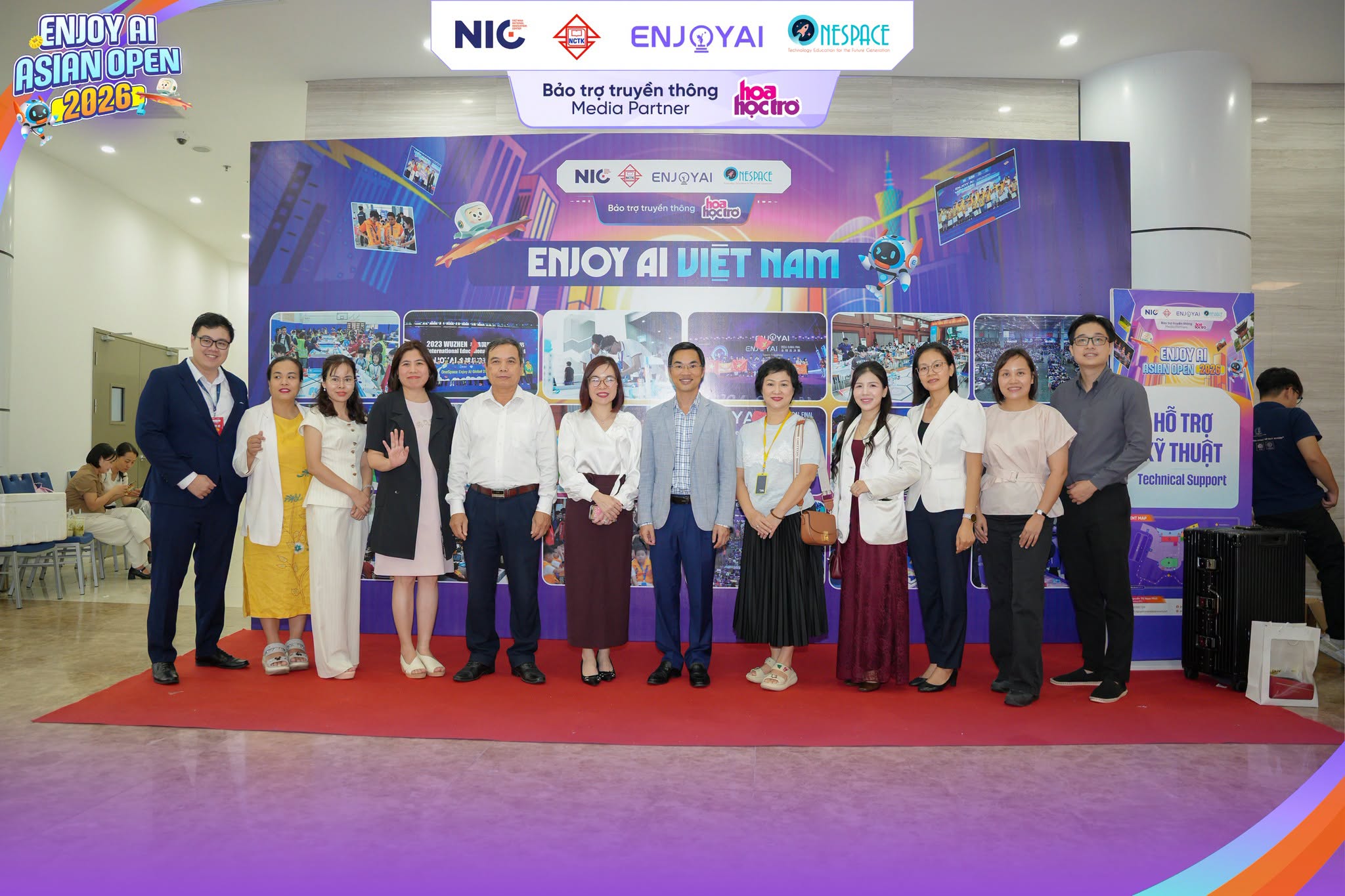
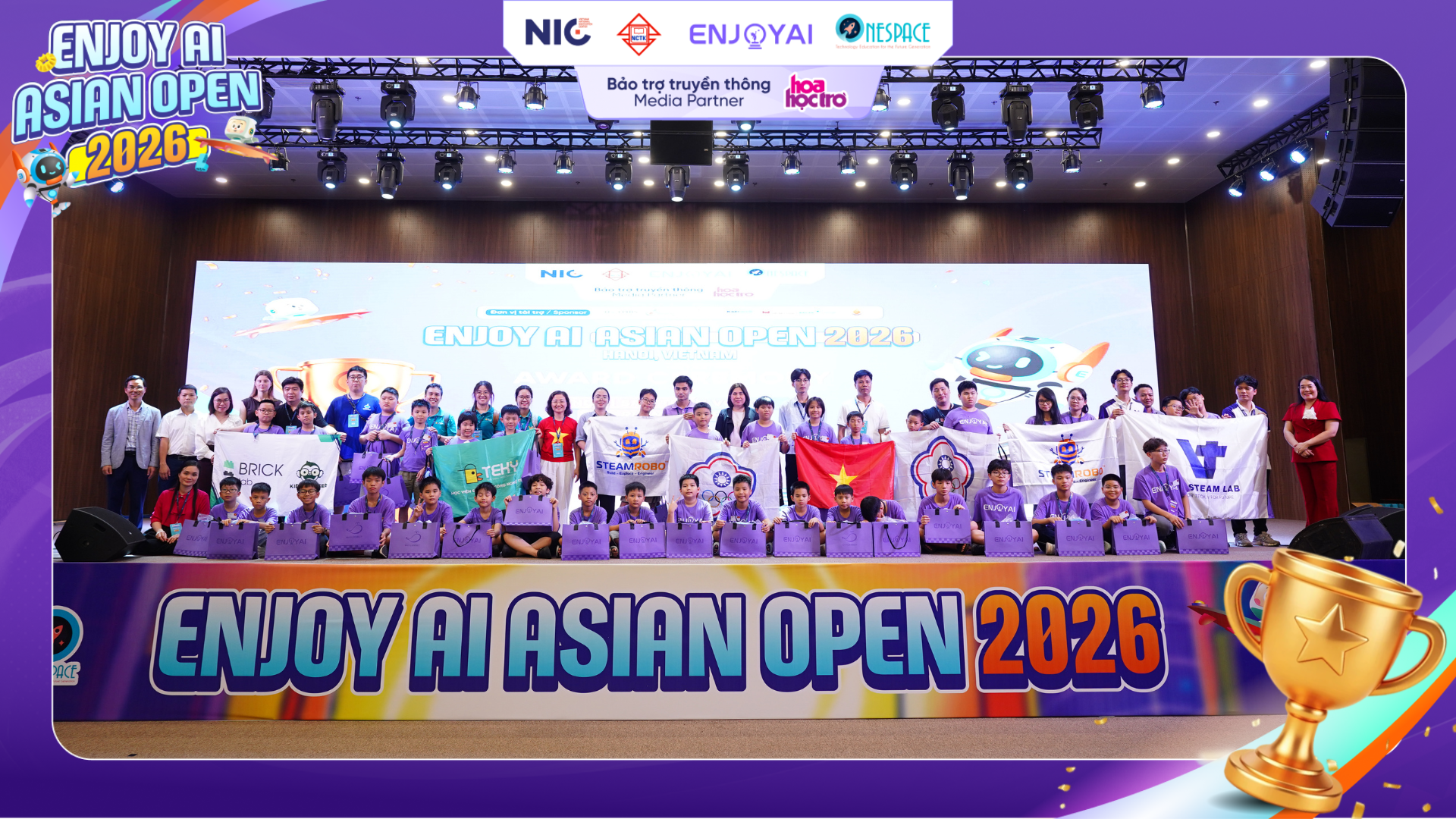
ENJOY AI is an international Robotics & AI competition for students, giving them the opportunity not only to learn about technology but also to take on real-world challenges through robot programming.
Here, knowledge does not remain confined to textbooks.
- Children write code.
- Robots come to life.
- Ideas are transformed into action.
- Every challenge calls for a solution of its own.
ENJOY AI is open to students aged 5–17, with competition categories designed around different age groups and skill levels. OneSpace organizes ENJOY AI in Vietnam and selects teams to participate in the international round.
Importantly, the competition goes beyond technical skills. Students also have opportunities to strengthen their creative thinking, problem-solving abilities, teamwork, and competitive confidence in a practical technology-driven environment.
Rather than waiting until AI becomes an integral part of their future careers to start learning about it, children can begin today.
So that as AI continues to advance, they will not simply be technology users. They will be empowered to create new possibilities with technology.
Explore more exciting courses at OneSpace here!